Mostrando las entradas con la etiqueta jungle. Mostrar todas las entradas

jueves, 8 de noviembre de 2012

The living bridges of Cherrapunji

One special root bridge, believed to be the only one of its kind in the world, is actually two bridges stacked one over the other and has come to be known as the "Umshiang Double-Decker Root Bridge."


 These bridges have formed from living roots over many hundreds of years and grow naturally stronger with each year. They are still used by those who live around them as passageways. 

In order to make a rubber tree's roots grow in the right direction - say, over a river - the Khasis use betel nut trunks, sliced down the middle and hollowed out, to create root-guidance systems.
The thin, tender roots of the rubber tree, prevented from fanning out by the betel nut trunks, grow straight out. When they reach the other side of the river, they're allowed to take root in the soil. Given enough time, a sturdy, living bridge is produced.


Pictures by Atlas Obscura's Wonderful Post on living root bridges.


martes, 10 de julio de 2012

The Leshan Giant Buddha


The Leshan Giant Buddha was built during the Tang Dynasty (618–907AD). It is carved out of a cliff face that lies at the confluence of the Minjiang, Dadu and Qingyi rivers in the southern part of Sichuan province in China, near the city of Leshan. The stone sculpture faces Mount Emei, with the rivers flowing below his feet. It is the largest carved stone Buddha in the world and it is by far the tallest pre-modern statue in the world.

The Mount Emei Scenic Area, including Leshan Giant Buddha Scenic Area has been listed as a UNESCO World Heritage Site since 1996.


martes, 8 de febrero de 2011

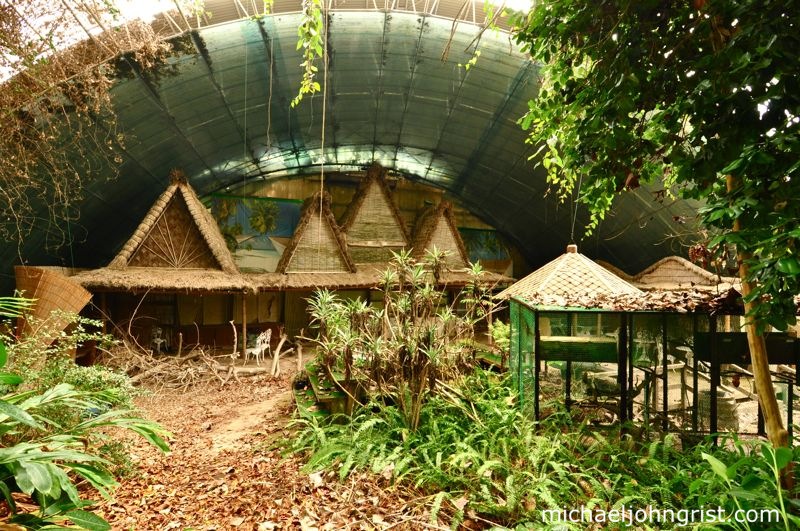
Izu’s abandoned Jungle theme Park #2 inside


Jungle Park, located in Japan, was easily the biggest green-house I’ve ever been in, and boy was it hot inside. H-O-T. And very humid. Within minutes I was soaked to the skin, and any time I had to climb something I was panting with the exertion. You can probably see that on the video a few times.
Wandering through its long tail-like corridor to the main jungle hub, I of course wondered where all the humidity was coming from. It’s sealed off from the outside, and has been closed for 7 years. Why isn’t everything inside baked and dead?


I guess there are two possible answers to that.
One- A security maintenance guy comes around and sprays everything/turns on the sprinklers once in a while.
Two- The place survives on what water it has already. I saw plenty of dead plants- they gave up their water to transpiration, it condensed on the glass sky, and fell as rain. In that way the place is slowly cannibalizing itself. It was odd though to see the poor shape the cactuses were in. I would expect them to be the hardiest- instead they were the ones most dead.
Perhaps I should talk a bit more about how huge it was. It was really huge.

You could buy Jungle Soft Cream and Cactus Smoothies at this snack shack.
Giants Greenhouse

photo-op


Partition between sections.

Map board with the map knocked out.

Primitive village
lots of brochures on the racks


drying cacti


totem pole graveyard


jungle theme photo board

view of ceiling


fallen jungle house

"primitive" clay pots

Post from Michael John Grist, read more on his website