Mostrando las entradas con la etiqueta hospital. Mostrar todas las entradas

miércoles, 10 de abril de 2013

The Llullaillaco Maiden

martes, 7 de agosto de 2012

North Brother Island


 A stunning set and brief history by the wonderful Mr. Motts, enjoy.


"The Brothers," as the islands are often called, are located in the East River, between Queens and the Bronx, NYC. They were claimed in 1614 and dubbed "duo De Gesellen" (or "The Companions"), and were left unoccupied for quite some time due to the strong and dangerous currents surrounding them. South Brother Island is the smaller of the two, and was only home to a private summer home for a few years until it burned down in 1909; it was purchased by Hampton Scows for $10.00 in 1979 and subsequently sold to the City of New York in 2007 (for around $2 million) to be preserved as a wildlife sanctuary. North Brother was purchased by the town of Morrisania (located in the Bronx) in 1871, and was home to a tuberculosis hospital built by the Sisters of Charity. The hospital was closed when New York City acquired the island in 1885 to build a new hospital for the treatment of infectious diseases. The diseases that were treated here varied as new germs invaded the city - they included smallpox, typhoid, tuberculosis, measles, diphtheria, scarlet fever, and polio.

 Many patients from the Renwick Smallpox Hospital on Roosevelt Island were relocated to North Brother once the new facility was built. A ferry located at 132nd Street in the Bronx transported staff, patients, and supplies to the island, yet it remained very isolated - there were no telephone or telegraph lines installed until as late as 1894. There were also dangers with transporting stricken patients in the winter, and much criticism was voiced after a six month old baby infected with measles perished en route to the island. During the turn of the century, overcrowding was a major issue when an outbreak occurred; everyday medical instruments were in short supply and were not cleaned or sterilized properly between the frequent uses. Tents were used when no more beds could fit in the pavilions; the cloth enclosures were precariously heated with wood burning stoves during the harsh New York winters, and a few eventually wound up in flames. The hospital had about 1,200 people in quarantine during a 1892 typhus outbreak.

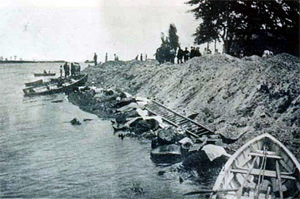
Bodies of General Slocum passengers line the shores of North Brother Island, 1904

Tragedy struck off the shores of the island on June 15, 1904, when the passenger ship General Slocum caught fire. Unmaintained fire hoses disintegrated in people's hands when they tried to use them, and the lifeboats were either tied down or painted onto the deck. The life preservers were made of a cheap granulated cork that were brought up to meet minimum weight requirements by placing iron bars inside, and crumbled away through holes in the tattered fabric. The captain continued his course into the wind instead of running the ship aground (his reasons being to avoid spreading the fire to the hospital buildings and oil tank), which fanned the flames even higher. Many passengers who jumped were taken to the bottom of the river due to the heavy garments worn at the time, and those who stayed aboard were consumed by flames or mangled by the still-turning paddle. The Slocum was eventually beached at North Brother, where the living had been pulled from the water by firemen and the staff at Riverside, and the dead were lined up along the shoreline. An estimated 1,021 people perished, with only 321 survivors.

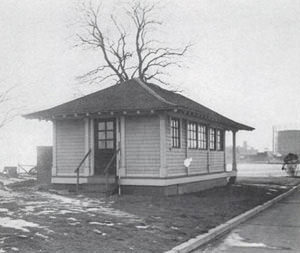
The most infamous patient that resided at Riverside might be Mary Mallon, also known as "Typhoid Mary." Mary was a carrier of typhoid, which means she had the disease but there were no symptoms or side effects, yet she could pass it to others. She worked as a cook at various places in Manhattan and Long Island between 1900 and 1907, where she transmitted the infection to a number of people. As they got sick or died she would find employment elsewhere, and she was soon questioned by health officials. Her response was that she did not believe she had the disease, and adamantly refused to cooperate. In 1907 Mary was taken into custody by police officers, and The Health Department gave her an ultimatum - either have her gall bladder removed (where typhoid carrier germs lived), or be exiled to North Brother Island. She refused the surgical operation, which was risky and unpredictable at the time, and was placed at the hospital for three years. Mallon resided in a bungalow, away from the main hospital buildings, and lived alone except for a dog as a companion.

Mary Mallon's Cottage at Riverside Hospital

After a lengthy court battle, where Mary described her life akin to a prisoner's, she was released from the hospital in 1910. She immediately returned to work as a cook under the pseudonym of "Mrs. Brown" at Sloane Maternity Hospital. An outbreak of typhoid that consisted of 25 separate cases was eventually traced back to the cook, and officials identified her as Mary Mallon. She was sent back to North Brother in 1915 to live the rest of her life there. She began working at the hospital in 1918, becoming a nurse and finally a laboratory assistant. Mary suffered a stroke in 1933, and remained bedridden at Riverside until she died on November 11, 1938. She had infected a total of 47 people, 3 of whom had died from the disease.

In 1943 a large tuberculosis pavilion was constructed on the island, but was never used for that purpose (supposedly due to the lack of staff personnel required to operate it). The passing of the GI Bill resulted in the shortage of housing for the city's colleges, and the building was used as a dormitory while the island was leased to the state. College students were transported to and from the island via the E 134th Street Ferry Terminal, by ferry boats Mott Haven and Greenwich Village.

These same ferries were also used for adolescents being treated for drug abuse when the city took control of the island once again in 1952 and planned its final use as a rehab center for serious cases of addiction. The idea was to get adolescents far away from the overcrowded jails and hospitals filled with time-hardened criminals, with a maximum stay of six months. The TB pavilion was converted to treat 100 boys and 50 girls, placed there by their parents or the court system. New admissions were bathed and searched for drugs, then placed in observation wards as they went through withdrawal "Cold Turkey." If the symptoms were too severe, they were tapered off the drug. The program turned out to be rife with corruption by the 1960s, and Riverside Hospital closed in 1963, leaving the entire island abandoned. It is currently off-limits to the public and patrolled often due to the proximity of a nearby prison complex on Rikers Island, as well as joining the purpose of its brethren as a bird sanctuary.


Information and photos © www.opacity.us 

jueves, 5 de julio de 2012

A Return to the Sepulchural Doctor's Shack

 An excerpt from Gakuranman's account of exploration of an old Medical shack in Japan:

A Return to the Sepulchral Doctor’s Shack

| Haikyo / Ruins |
 
Just shy of a year ago I came across an age-old medical shack hidden in the heart of the Japanese countryside. Brimming with mystery and intrigue, I thought I had seen everything the place had to hide, but a repeat visit with a fellow urbexer unearthed an abundance of creepy new discoveries. Just in time for Halloween…


The Doctor’s Shack, as I’ve nicknamed it, is a an old medical clinic abandoned around 60 years ago dating back to pre World War 2. The fact that a wooden building has survived this long along is quite remarkable in itself, but the shack is filled with a plethora of old medicine bottles and books labelled in German, likely harking back to the Meiji Period around 1870 when the government adopted German systems of medicine. According to Jikei University, one of the hallmarks of the German system was an “authoritarian discipline and an emphasis on research over treatment: patients were usually regarded as objects or even as raw material for medical research.”


My haikyo partner Florian pointed out a dusty, cold gynaecologist’s chair resting unceremoniously in the corner of the room that I had missed the first time around. Among the various containers filled with strange substances and toxic powders, were also rusty cutting instruments and old vessels for dispensing liquids. Literature scrawled in German text was strewn all over the upper floor of the building. The photo below of Thrombogen appears to be the German term for Thrombin, a drug administered to stop bleeding.


These were the sort of items I was consumed with photographing on my first visit. The sight of medicines that could be as much as 100 years old piked my curiosity and I was overtaken with an intense longing to know everything about its history, as well as being very concious of how fragile the place was. Perhaps this is why I overlooked much of the darker side of the Doctor’s Shack my first time around. The only thing I remember feeling an uncomfortable awareness of was the creepy deck chair tucked away at the end of a corridor on the second floor. But this was to be the first of many eerie, dark sights…


Florian was busy shooting the lower floors of the building, so I creaked up the staircase to the second floor to get some interior shots while the light was still good. The first time I had visited, the sun was already beginning to set and it had soon become pitch black inside causing me to miss the bizarre discovery below.


A footprint, or half of one had been left bleached into the woodwork. But that’s not the freaky part – this half-footprint was on the ceiling
I considered how it might have gotten there. Kids playing a trick? The shape of the foot was very pronounced and it was not made by any sort paint or ink; the mark was stained into the wood. Even if someone had played a tried and somehow managed to put a footprint on the ceiling, why was it only half a footprint?? Examining the photo above, the footprint cuts off where it meets the next wooden slat, leading me to think that perhaps the slat had been flipped upside down and that the other half of the print was on the floor above.
But there was no floor above…


Batting off numerous humming mosquitoes, I walked underneath the mark and continued down the hallway to take another look at the deck chair. I don’t quite know what it is about the thing, but staring at it sitting right at the end of a tiny corridor really creeped me out. Something, something sepulchral, held me back…
I could still hear Florian snapping away downstairs and cursing every now and then at the swarms of insects defying the colder weather and hunting for our blood. Another famous sight within the shack caught my eye in the Doctor’s bedroom.

It reads:
「健全ナル国民ノ育成ハ師表タル者ノ徳化ニ俟ツ。コトニ教育ニ従フモノ其レ奮励努力セヨ.
I’ve tried asking Japanese friends about this, but it seems to be some sort of old idiom. The only record I’ve been able to find of it was on this website, which talks about it being an Imperial rescript, or words spoken by the Emperor at some point in time. Translating it yields something like this:
The development of a healthy nation is dependent on the morals of its leaders; special effort should be put into education.

Stepping precariously into the room next door, I was greeted with a terrible sight. Not a year has passed since I last visited, but a huge hole in the wall has appeared where damage due to a fire had been present. It looks like it’s due to natural degradation, but it’s very worrying for the structure. The staircase is already sloping at a dangerous angle and the front porch long since collapsed. I really have doubts as to whether this place will remain standing much longer…
Florian and I swapped floors and I got back to poking around the corners of the hut. Another delicate item emerged that I had overlooked on the previous visit – the chilling doll with blood-red lips! It’s documented in the the haikyo book I have, but I was disappointed not to find it before, having written it off as stolen or destroyed.


I had bought a headlamp for this visit as I’d forgotten my torch (and even misplaced the panel for my tripod, making it useless!) The doll was a perfect find for this sort of place. Creepy, mysterious and just a little bit cute. I wonder what colour eyes it used to have…
The inside of its head had been pulled out, leaving a gaping hole in its skull and the tattered rags for clothes were disjointed from the neck. I experimented with different lighting directions and intensities and holding my camera steady for sharp exposure as best I could. The hordes of mosquitoes were not letting up though, and the dozens of bites I received in my efforts to remain still would not fade for weeks after. A real blood sacrifice to the doll…


I darted back into the main medicine room just as Florian was starting to finish up. There’s only so many ways one can photograph the rows of bottles on the shelves, but I opted for a low angle shot this time. The good light made nice exposures much easier. I’d still like to try an external flash though.
One area that I wasn’t able to explore last time was the house near the shack. The ‘place where a God lives’, or so says the black stone in front of it. There were various medicines inside the house and although they could have been moved there by previous explorers, I got the feeling that people who had a connection to the medical clinic lived there.


All sorts of old items were lying around, mostly trashed, including a rounded pair of glasses, old letters and kitchen utensils. A weird spider’s web caught my eye most though. Have you ever seen threads like this?


One last item I found inside the accompanying storage house was an old hollowed-out lamp with the character 大 on it, meaning ‘large’. The headlamp came off and I played around with some interesting illuminating effects. Fortunately the mosquitoes couldn’t get inside this building, so it was a relatively peaceful time.


Afterwards, Florian and I scouted the surrounding area, checking out a couple of other abandoned houses (one of which looked pretty new and was full of untouched and expensive-looking items!). We’d missed the train, so had quite a wait until the next one, but enjoyed sitting by the river munching on a couple of onigiri to regain some strength and complaining about how itchy all the bites we’d taken were. Ahh, the things we haikyoists go through for the explore…
Be sure to read Florian’s writeup of the explore as well!

Source

viernes, 8 de junio de 2012

Sanatorio Lohner


Nestled in a Swiss valley, a small sanatorium lies at about 3,770 feet above sea level and surrounded by beauty. The institution was constructed in 1905 as a private hospital to treat tuberculosis. The 5-story main building is symmetrical and decorated in Art Nouveau style; inside were 76 patient rooms, a breakfast room, a recreation room, sterilization rooms, and various offices. 

Two large verandas faced south towards the opposite side of the valley, and were used for heliotherapy (light therapy) and fresh air treatments. The main building is attached to a semicircular medical villa resting on supports, built in 1934. The facility also includes a doctor's residence, wash house, and staff house. In 1919 the government purchased the property for 470,000 francs and used the sanatorium as a military hospital until 1920. Tuberculosis treatment resumed until the gradual eradication of the disease reduced the number of patients - the hospital was eventually shuttered in 1962.

The doctor's residence is still being lived in, however the rest of the property has begun to deteriorate. Although the main building is in good condition for being closed for so long, it does require some rehabilitation work, while the laundry building is in very poor shape. The once-grand front lawn adorned with a large fountain is now a grazing field for a herd of goats.
* Note: the name "Sanatorio Lohner" is a pseudonym; the real name of this location is currently undisclosed.


via Opacity