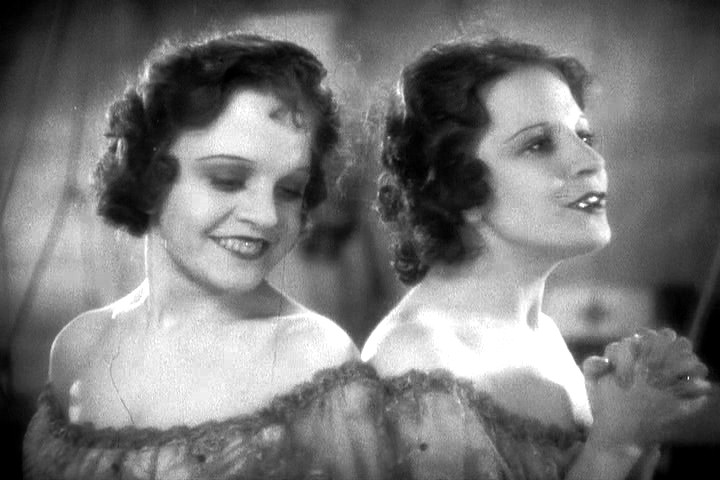
Original caption: Famous Siamese twins Daisy and Violet Hilton (of Freaks movie and sideshow fame) enjoy warm surf at Miami. (Feb. 25, 1945) Paul Colston Collection.
Contrary to popular belief, outright exploitation was not very common in sideshow. The majority of human marvels displayed themselves for their own reasons and quite often reaped massive financial and personal rewards for doing so. However, of the few performers who were exploited against their will, the tale of Daisy and Violet Hilton ranks as one of the worst.
 Daisy and Violet Hilton were born in Brighton, East Sussex, England on February 5, 1908 to a young, unwed barmaid, Their birth name was Skinner however their impoverished and unmarried mother, Kate, could not fathom the responsibilities involved in raising a pair of girls joined. She sold the twins to her boss and midwife Mary Hilton.
The sisters were pygopagus twins - conjoined at the hips and buttocks. They shared blood circulation and were fused at the pelvis but shared no major organs. A medical account of the birth and a description of the twins was provided for the British Medical Journal by Dr James Augustus Rooth[1], the physician in charge at the time of their birth.
Daisy and Violet Hilton were born in Brighton, East Sussex, England on February 5, 1908 to a young, unwed barmaid, Their birth name was Skinner however their impoverished and unmarried mother, Kate, could not fathom the responsibilities involved in raising a pair of girls joined. She sold the twins to her boss and midwife Mary Hilton.
The sisters were pygopagus twins - conjoined at the hips and buttocks. They shared blood circulation and were fused at the pelvis but shared no major organs. A medical account of the birth and a description of the twins was provided for the British Medical Journal by Dr James Augustus Rooth[1], the physician in charge at the time of their birth.
 He reports that subsequently the Sussex Medico-Chiurgical Society considered separation, but unanimously decided against it as it was believed that the operation would certainly lead to the death of at least one of the twins. He notes that these twins were the first to be born in the United Kingdom conjoined and to survive for more than a few weeks.
Soon after acquiring the twins, Mrs. Hilton put them on exhibition. They were managed by Ike Rose of Rose's Royal Midgets fame and exhibited alongside Rosa and Josefa Blazek, probably the first time in history that two sets of Siamese twins were ever shown together.
He reports that subsequently the Sussex Medico-Chiurgical Society considered separation, but unanimously decided against it as it was believed that the operation would certainly lead to the death of at least one of the twins. He notes that these twins were the first to be born in the United Kingdom conjoined and to survive for more than a few weeks.
Soon after acquiring the twins, Mrs. Hilton put them on exhibition. They were managed by Ike Rose of Rose's Royal Midgets fame and exhibited alongside Rosa and Josefa Blazek, probably the first time in history that two sets of Siamese twins were ever shown together. Daisy and Violet were later taken on an Australian tour with Mary Hilton, her husband Henry, and their daughter Edith. While in Australia, Edith married Myer Myers, a carnival balloon salesman.
 According to many sources, including the autobiography written by the Hilton sisters in 1942, Mary Hilton was a strict, physically abusive, exploitive and corrupt human being. The twins were ‘trained’ and ‘groomed’ to sing and dance in the vaudeville tradition.
While this training was in progress the horrific abuse and dehumanizing continued. When the girls finally began touring, they were seen as little more than possessions by the Hiltons.
According to many sources, including the autobiography written by the Hilton sisters in 1942, Mary Hilton was a strict, physically abusive, exploitive and corrupt human being. The twins were ‘trained’ and ‘groomed’ to sing and dance in the vaudeville tradition.
While this training was in progress the horrific abuse and dehumanizing continued. When the girls finally began touring, they were seen as little more than possessions by the Hiltons.The twins proved to be hugely successful and the toured extensively beginning at the age of three. On stage, the pair likely looked like dolls, their blond hair in curls and bows on their shoes. Violet played the piano while Daisy played the violin.
When Mary Hilton died, she willed the twins to Edith and Myer. The Myers relocated to the United States and used part of the twins' fortune to built a luxurious, Frank Lloyd Wright-inspired home in San Antonio, Texas.
Daisy and Violet spent the majority of the 1920s touring the United States on vaudeville circuits, playing clarinet and saxophone, and singing and dancing. The sisters were a national sensation, counting among their friends a young Bob Hope and Harry Houdini, who allegedly taught them the trick of mentally separating from one another.
Billed as ‘The United Twins’, their tours of Germany, Australia and the USA often saw record crowds. The twin brought in enormous amounts of money. Mary Hilton kept every penny.
When Mary finally died in Birmingham, Alabama, the guardianship of the twins fell to Mary’s daughter Edith and Edith’s husband, Meyer Meyers. They were even worse than Mary as they controlled every movement the twins made. They also proved to be poor agents as they insisted on keeping the girls ‘dolled up’ as little girl well past the age it was acceptable. Critics took notice and the twins were allowed to grow up, but only a little.
The mistreatment and corruption continued under the dictatorship of Edith. Edith purchased a mansion in San Antonio with the money the twins earned as a headquarters as the twins spent much of the 1920’s touring the United States on vaudeville circuits. It was on these circuits that they met Bob Hope and their dear friend Harry Houdini. Their popularity, at this point was near its peak and as a result they became subject to scandal.
The twins had befriended their advance agent, William Oliver. Oliver’s wife Mildred was suspicious of the relationship and accused William of improper acts. A postcard from the twins signed to William ‘with love’ prompted Mildred to file for divorce and sue the twins for $250,000. Oddly enough, this frivolous lawsuit was the catalyst for the Hilton’s freedom.
During a visit to San Antonio lawyer, Martin J. Arnold, the truth came out. As the Meyer’s were out of the room the Hilton sisters told the lawyer of their life of abuse and captivity. The lawyer was flabbergasted and immediately took on the twins’ case. He took the twins into protective custody.
In April of 1931 Judge W.W. McCrory awarded a large sum of money – some reports say as much as $100,000, to the sisters and granted the pair their freedom.
The girls had spent 21 years in abject slavery.
Daisy and Violet became citizens of the United States and returned to show business. They hosted their own show, ‘The Hilton Sisters’ Revue’, and stared in the 1932 film Freaks.
Everything seemed to be perfect in the life of the Hilton sisters; however the pair soon began to self destruct. Due to too many years of solitude, suppression and deprivation the girl wallowed in excess. They had numerous affairs, legal problems, clashes with that media and a couple of short publicity marriages. Their popularity nosedived.
 Violet had a string of highly publisized love affairs with celebrity boyfrinds, and became engaged in 1933 to bandleader Maurice L. Lambert. Violet and Lambert began a nationwide search for a clerk who would issue them a marriage license.
Each of her requests - in 21 states - was denied on moral grounds, and lawyers were brought in to argue on Violet's behalf. One New York clerk refused to issue the license because Daisy was not also engaged. Though briefly engaged to Jack Lewis, another bandleader, she deemed him too shy for marriage to a Siamese twin.
Violet had a string of highly publisized love affairs with celebrity boyfrinds, and became engaged in 1933 to bandleader Maurice L. Lambert. Violet and Lambert began a nationwide search for a clerk who would issue them a marriage license.
Each of her requests - in 21 states - was denied on moral grounds, and lawyers were brought in to argue on Violet's behalf. One New York clerk refused to issue the license because Daisy was not also engaged. Though briefly engaged to Jack Lewis, another bandleader, she deemed him too shy for marriage to a Siamese twin.Unable to get married, Violet and Maurice split. Two years later, however, the twins' agent Terry Turner announced that he could arrange for Violet to marry after all - she only needed a groom.
Chosen for the role was Violet's dance partner and a longtime confidant of the twins, James Walker "Jim" Moore. The wedding, such as it was, took place on July 18, 1936, at the Texas Centennial Exposition on the 50-yard line of the Cotton Bowl. Daisy, too, got to experience wedded bliss when she married vaudeville dancer Harold Estep, stage name Buddy Sawyer, at Elmira, New York, on September 17, 1941. Their marriage lasted two weeks.

Original caption: Siamese Twins Daisy and Viola Hilton - Freak Siamese twins are capable of earning living in practical pursuits. These English-born twins have just come from San Antonio, Texas. Photo shows Daisy Hilton typing while her inseparable sister Viola sews. They are both accomplished typists, needlewomen, and are expert in the culinary art. (Photo by Underwood & Underwood, Nov. 29, 1924)
The sisters in the cafeteria of the Newhouse Hotel, Salt Lake City, Utah. They were scheduled to perform at the RKO theater.
After the decline of vaudeville, the twins, like countless others, turned to Hollywood. In 1950 the sisters appeared in the film Chained for Life as Dorothy and Vivian Hamilton, vaudeville singers. In the film, Vivian takes a dislike to the musician who is courting her sister.
Dorothy, on the other hand, is so smitten that she begs doctors to separate her from her twin so that she might marry. In the end, Vivian shoots and kills Dorothy's beau with a pistol grabbed from a sharpshooter's prop cart. The judge - and the audience - are left to decide whether to send innocent Dorothy to jail, or let guilty Vivian walk free. Chained for Life was a colossal failure, banned in many places due to its lurid subject matter.
 Struggling to survive, the twins opened a hotdog stand, The Hilton Sisters' Snack Bar, in Miami, in 1955, but the business failed in part due to the objections of fellow vendors.
The Hiltons’ last public appearance was at a drive-in movie theater in Charlotte, North Carolina in 1962. Their tour manager abandoned them there, as the tour was a failure and he was tired of losing money.
He left them without any money or transportation and the twins simply decided to settle in Charlotte. A kind grocery store manager hired the sisters to work in his shop, where they checked and bagged groceries.
 On January 6, 1969, after battling the Hong Kong flu for some weeks, the twins failed to report for work. Their boss called the police and the sisters were found dead in their small trailer. Daisy died first and forensic evidence tragically suggested that Violet lived for two to four days afterwards.
Having no surviving family, the twins were laid to rest beside a Vietnam soldier named Troy Thompson, the son of an acquaintance. At death, the twins owned but $1,000, a far cry from their formerly vast fortune. Those who met them late in life describe the quintessential "fallen stars": the twins spoke and dressed as they had in their heyday, well into the 1960s.
Despite the sad end to their lives, the memory of the Hilton sisters still lives on. In 1997, a Broadway musical loosely based on the sisters’ lives, Side Show, with lyrics by Bill Russell and music by Henry Krieger, received four Tony nominations.


 Blanche Dumas was born on the Caribbean island of Martinique in 1860, to a French father and a biracial mother. She had a third leg attached to her sacrum, and her two primary legs were said to be imperfectly developed. The third leg was without a mobile joint but had a bend in it where the knee would have been.
 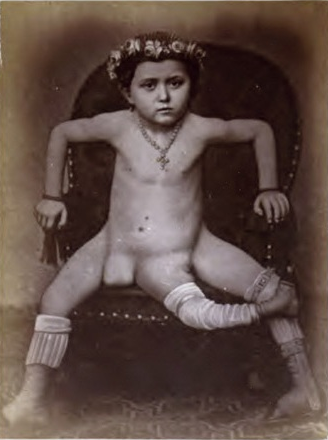 Stories of Blanche all mention her pronounced libido. She moved to Paris later in life and became a courtesan, and allegedly, upon hearing about the three-legged, man with two penises and four testicles, dos Santos, who was touring at the same time, she expressed a desire to have sex with him. According to Gould and Pyle, "There were two vaginae and two well-developed vulvae, both having equally developed sensations. The sexual appetite was markedly developed, and coitus was practised in both vaginae."