Mostrando las entradas con la etiqueta Marvels. Mostrar todas las entradas

sábado, 24 de agosto de 2013

The Story of Richard Sandrak: Little Hercules.


Richard Sandrak (born 15 April 1992), also known as Little Hercules, is aUkrainian-born, American bodybuilder, martial artist and actor, known for his muscular physique at an extremely young age, and for his appearance in the documentary The World's Strongest Boy.
Richard Sandrak was born April 15, 1992, in a small village in Ukraine, to Pavel Sandrak, a martial arts world champion, and his mother, Lena Sandrak, an aerobics competitor. In 1994, Sandrak, aged 2, moved with his family toPennsylvania, where his parents believed he would have a better life. Sandrak began his training soon after they arrived in the states, when Sandrak was still an infant. His father, who had trained in Taekwondo, introduced him to various stretches and light weight training.
 The family subsequently moved to California, with the intention in order to break into show business. The family met trainer Frank Giardina, while touring one of Giardina's gyms, and hired him to help gain publicity for their son.


During his childhood, Sandrak was kept in strict seclusion. Dedicating all of his time towards training, Richard never had time to play with friends and experience a typical childhood. Being on a strict diet enforced by his father, Sandrak was never able to eat junk food or any sweets. Sandrak recalls days when his father would eat pizza in front of him, while he was left to eat a head of lettuce. According to Giardina, Sandrak was made to repeat intense exercises as punishment if he got something wrong. Sandrak states his father never forced him into bodybuilding. "I've never been forced to train or do anything against my will," he said. "My parents used to train all the time and I wanted to join in. It was mostly my choice. It's just what I grew up doing. I was never forced. It was never an issue."
His parents started him out with light exercises and martial arts techniques which soon progressed into more intensebodybuilding training. At the age of six Richard was maxing out at 180 lb (82 kg) on standard bench-press. During this early age he claimed his title as world’s strongest boy as well as his nickname "little Hercules". At the age of eight he was bench pressing 210 lb (95 kg).
Sandrak began traveling across the country to participate in competitions, promotions for nutrition products, and photo shots for numerous magazines. He also appeared on several TV and radio shows, such as The Howard Stern Show. As he got older his career gradually waned. His Hollywood debut was as the title character in the 2009 film, Little Hercules.
Giardina quit after he came to feel that Pavel's parenting was criminal, and Pavel threatened to kill Giardina. Not long after Pavel was imprisoned for physically assaulting his wife, leaving her with a broken wrist and nose, an event for which Sandrak himself called police. By September 2007, Pavel had been recently released from prison, though held under psychiatric guidance, and faced the possibility of deportation.
A year after Lena and Sandrak left Pavel, Sandrak was profiled in the documentary The World's Strongest Boy, which detailed his ability to do splits, his ability to bench press three times his own body weight, and the fact that his body had less than 1 percent body fat, which can be lethally low. Though medical experts argued that such muscular development requires testosterone that is not found in children younger than 10, and speculated that steroids were involved, Lena Sandrak denied that her son used such substances.
By age 15, Sandrak continued to train five times a week, 90 minutes per each session, and ate food more typical of others teens like pizza. His live-in manager, Marco Garcia, helped normalize his life, and produced Little Hercules in 3-D. Sandrak hopes to make more movies, and to devote his time to raising awareness of childhood obesity.


Here is an excellent interview with Richard about his father and his past. http://youtu.be/9yXDK0z5-74 


martes, 20 de agosto de 2013

Blanche Dumas, the Three Legged Courtesan


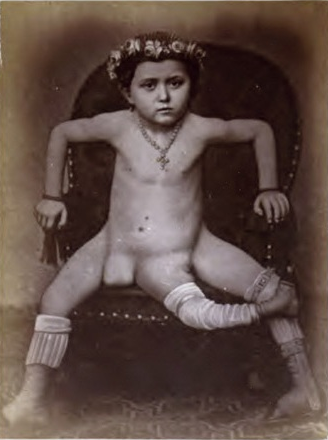
Blanche Dumas was born on the Caribbean island of Martinique in 1860, to a French father and a biracial mother. She had a third leg attached to her sacrum, and her two primary legs were said to be imperfectly developed. The third leg was without a mobile joint but had a bend in it where the knee would have been. 


Her pelvis was wider than normal and she had double genitalia as well as a duplicate bowel and bladder. To the right of her middle leg was the stump of another limb; it's unknown at this time whether this stump was naturally occurring or the site of a surgical amputation, but promoters sought to maximize its appeal by adorning it with nipples and advertising it a pair of "well-formed" extra breasts!

Stories of Blanche all mention her pronounced libido. She moved to Paris later in life and became a courtesan, and allegedly, upon hearing about the three-legged, man with two penises and four testicles, dos Santos, who was touring at the same time, she expressed a desire to have sex with him. According to Gould and Pyle, "There were two vaginae and two well-developed vulvae, both having equally developed sensations. The sexual appetite was markedly developed, and coitus was practised in both vaginae."

Left: Rare photo of young Blanche Dumas, clearly showing her undeveloped (or amputated) fourth leg. Right: Adult, sexualized Blanche with nipples painted on her leg stump. This is the basis for the woodcut above. Both photos submitted by an anonymous reader.

miércoles, 5 de junio de 2013

Charlie No-Face, AKA the Green Man.

WARNING:CONTAINS SOME GRAPHIC AND DISTURBING MATERIAL


Raymond "Ray" Robinson was born on October 29th, 1910 just a couple days shy of Halloween. 


As a young boy of eight years old, Robinson was badly  injured by an electrical line on the Morado Bridge, outside of Beaver Falls, Pennsylvania, while attempting to view a bird's nest. 

The bridge carried a trolley and had electrical lines of both 1,200 volts and 22,000 volts, which had killed another boy less than a year earlier. Robinson was not expected to survive; he lived, but he was badly scarred and lost his eyes, nose, one ear, and one arm.


Robinson lived in Koppel and spent his days at home with relatives, making doormats, wallets, and belts to sell. Because of his appearance, he rarely ventured out during the day. However, at night, he went for long walks on a quiet stretch of State Route 351, feeling his way along with a walking stick. 

  Local residents, who would drive along his road in hopes of meeting him, called him The Green Man or Charlie No-Face. They passed on tales about him to their children and grandchildren, and people raised on these tales are sometimes surprised to discover that he was a real person who was liked by his family and neighbors.

Groups of locals regularly gathered to search for him walking along the road. Robinson usually hid from his curious neighbors, but would sometimes exchange a short conversation or a photograph for beer or cigarettes. Some were friendly, others cruel, but none of his encounters deterred Robinson from his nightly walks. He was struck by cars more than once. He stopped his walks during the last years of his life, and retired to the Beaver County Geriatric Center, where he died in 1985 at the age of 74

 Robinson became a local myth in the Pittsburgh area, and his real story was obscured by urban legend:

This Excerpt mentioned Robinson in full blown Urban Legend glory:

"If Halloween puts you in the mood for a creepy tale, ask a local old-timer to tell you about the Green Man.


Just mention that to someone who grew up in Western Pennsylvania in, say, the 1950s, and there's a good chance he or she at least has heard of this monstrous creature, said to stalk remote roads at night, especially this time of year.

Depending on when and where you heard the legend, this man glows green as a result of being struck by lightning, or being shocked or otherwise transformed in some industrial accident, and he haunts South Park, or the North Hills, or the skinny country lanes around Washington, Pa. 

"I've heard McKees Rocks, I've heard Brookline. You can pick the haunting of your choice," says Mike Diehl, the Allegheny County parks superintendent who's heard about the Green Man for the 25 years he's lived hereabouts.

He hands the phone to his assistant, Marie Werner, who grew up in Elizabeth Township and graduated from Elizabeth Forward in 1968. Long before high school, thanks to her older brothers, she knew about the Green Man. You had to beware of him along South Park's Snowden Road -- a twisty, woodsy, unlit stretch popular for necking and other pubescent tricks and treats.
"The legend goes that he roams that hollow late at night and chases the parkers and the loafers," says Werner, who admits to having gone there a few times.
"I never saw him," she adds, though many friends claimed to.
She is convinced the Green Man still is there -- at least in the imaginations of locals and the teens who still hang out along the road.
"Absolutely," she says. "Right now, it's a big topic in the high school. ... The legend is still strong."
To this day, confirms South Park historian Jo Pelesky, the nearby tunnel that Piney Fork Road and its namesake creek follow under the old B&O railroad is known as the "Green Man Tunnel." Like others, she describes it as a spooky-looking spot, though she knows that's not the only reason it gave adolescents gooseflesh. 

"The guys used to take their girlfriends there, you know," says Pelesky, who grew up in that area in the 1930s when it was all coal mines. She's heard that one night back in the '40s or so, one guy, perhaps in a costume, was out there peeking in the steamy windows of the cars, "and scared them half to death." She's even heard that it was a mentally deranged person who was later institutionalized, but, "I can't verify that."
In her 72 years, Pelesky hasn't seen the Green Man. "Of course, I never parked in that tunnel."

Temple, now 58 and a printer who works the overnight shift at the Post-Gazette, says the Green Man made such an indelible impression on him that he's written a story to keep it alive for his grandkids. His tale goes back to 1956 when he and Ray Griffin were 16-year-old Lawrenceville pals.

"One evening in June," he writes, "Ray and I were hanging out with two other friends -- Guy Muto and Jim Walsh -- and as we had nothing better to do, Ray suggested that we go up to see the Green Man. This was an offer I couldn't refuse."
They piled into Temple's '51 Ford and headed north for the Turnpike, which they took to Route 18, then followed that to the light in Koppel, turning left on Route 351.
"As soon as we started up the road," his story continues, "Ray announced that is the road the Green Man always walked on. There was a long silence and I could feel the goosebumps and when we finally did say something, we seemed to be whispering." 

Perhaps inevitably, Temple recalls that "it was a bit foggy and the visibility was not real good at times." As they came around a bend, "Ray yelled, 'There he is!' and the car lights shined directly on the Green Man."
Temple, who was driving, describes nervously hitting the brakes, then the gas, then the brakes, while chattering with his similarly freaking friends.
They turned around and passed the Green Man once more, but were too terrified to stop.
Still, their exploit was impressive enough that older boys actually spoke to them about it. "We were still the same jerks that we were before ... but now we were minor celebrities." 

That summer, Temple returned many times -- sometimes with those buddies, sometimes with others. In fact, he recalls traffic jams caused by cruisers who actually stopped to talk with the Green Man. The first time Temple did that, he got a parking ticket (he came to believe that "the local police used the Green Man to make the township a few extra dollars").
Later, after asking the Green Man if he could, Temple snapped some color photographs of him. 

The pictures were the perfect pickup pretext, Temple writes. "I would have a friend go to the counter of a drive-in restaurant and mention within hearing range of a nice-looking girl that I had pictures of the Green Man, and the next thing you knew, there was a tap on the window of my car and a girl wanting to know if she could see the pictures. When they asked where he was located, I told them to give me their phone number and I would call them the next time that I would be going up. Sometimes it worked."
But Temple started to feel bad about this freak show, because he'd learned the Green Man was a nice human being. It was just that, as a boy, he had been severely shocked, and that's why most of one arm was missing and his face was so disfigured.
In fact, the locals referred to him as "Charlie No Face," which "I didn't think was too nice a name," Temple says.
He could remember that his first name was Ray, but not his last name or other details.
He's not even sure why people called him the Green Man, because he wasn't, but surmises that the plaid shirts he often wore -- as in his snapshots -- would reflect green in people's headlights.
Or in their imaginations. 

"You have to realize how things were in the '50s," Temple says, recalling the prevalence of movies about flying saucers and aliens, inspired by real-life fears like that of being beaten by the Communists in the newly launched space race. 

In July 1957, Temple joined the Air Force. After he got out in '61, he sought the Green Man several times, but never saw him again. He wonders what happened.
"This is part of Western Pennsylvania history," he says, and one he's never seen fully chronicled, which is why he urged this reporter to check it out.
Well, hard facts are scarce, but Temple's story does check out in Koppel. Mention the Green Man to folks of a similar age -- say, at the borough office, or at Ann's Market & Deli across the street -- and they well remember him. 

"We used to go out and give him beer," says 60-year-old Pete Pavlovic, from behind the counter at Ann's. The former newspaper photographer, who once did a story about the Green Man for the old Koppel paper, says his real name was Ray Robinson, and he's long dead. (His curiosity piqued, Pavlovic called an area funeral home and found that Raymond T. Robinson died in 1985, at age 74, of natural causes.)

People used to run into this same building, when it was his dad's market, and insist they'd seen a monster on the road. "They wanted to call the police. You'd have to explain. Then they'd usually go back up looking for him."
Even locals were scared of him when they were kids. Around 1940, the first time Frank Pellegrine delivered groceries to the family's house and saw Robinson, "I dropped the boxes and run." 

Another store worker, Olive Cearfoss, actually shivers recounting the Sunday that she walked past the Green Man on her way back to town from a swimming hole down the road. "I was so scared it was unreal."
But once they got past his appearance, they realized he wouldn't hurt anyone.
"Helluva a nice guy," says 62-year-old Phil Ortega, who used to take his dates out to see "Charlie," and also took him Lucky Strikes. Apparently, some people used to regularly visit him and pay him other kindnesses. Ortega believes he liked talking with people on the road.
Still, many agree, it was a sad situation, and one that often got out of hand, says George Richner, who still lives along the road.
"The cars come from, Christ, as far away as Chicago one time," he says, pointing to one pull-off where gawkers gathered.
Like others, he wasn't aware of any living relatives, but he offered to take this reporter to the old Robinson house. There, even he was surprised when his knock was answered by Robinson's sister, Volaria Rice, who's also in her 80s.
She embraced her old schoolmate, and kindly invited the visitors in, but was adamant about not wanting to talk about her brother. "I just want to leave it the way it is."
Chatting with her briefly -- about how much she worried about her brother drinking on his walks out on that narrow road -- makes it easy to realize how painful some of her memories must be.
Today, her brother most certainly would get better medical treatment.
Perhaps he'd get better treatment from other people, too.
That he didn't may be the scariest part of the Green Man's lingering legend."

(Saturday, October 31, 1998
By Bob Batz Jr., Post-Gazette Staff Writer)

 
Sources: Bauder, Bob (2007-03-10), "Charlie No Face: The Life and the Legend", Beaver County Times

Wikipedia 

sábado, 18 de mayo de 2013

Guanajuato trip: Museo del las Momias


********WARNING: contains graphic content below*********


We traveled all the way to Guanajuato, Mexico to visit the smallest mummy in the world.  What we found was an astounding and horrifying collection of hundreds and hundreds of poor souls, stripped down and lined up in air-conditioned glass coffins. 
I've previously posted about the museum when it was listed as one of the world's most horrifying destinations, but here is a little background in case you didn't see that post:

The museum is what's left over of a sunken crypt where the deceased were stacked in the event that family members could not afford the annual grave tax. The graveyard was very crowded from a typhoid outbreak and the dry hot conditions naturally mummified the remains. One tourists began taking an interest, a fee was charged and the mummies remain desecrated for all eternity in the museum. 

It was an indescribable experience, very distrubing, and I'm pretty sure we are cursed now~!!!

More to come on the other horrors of our trip ^_^


Abuelita


I think we are cursed....


Yup...


Definitely cursed.


Smallest Mummy in the world- a fetus


Mother of the smallest mummy, pregnant at death


RIP??


Baby with interested skull deformity


Goodbye Guanajuato


viernes, 8 de marzo de 2013

The 16-Inch Waist Of Émilie Marie Bouchaud


In the late 19th century, "tightlacing" among women was in vogue. Émilie Marie Bouchaud or "Polaire" was famous for her tiny, corseted waist, which was reported to have a circumference no greater than 16 inches and at one time measured 14.

The algerian-born singer and actress's striking appearance, both on and off stage, contributed to her celebrity. For her 1910 supposed "debut" in New York she provocatively allowed herself to be billed in the advance publicity as "the ugliest woman in the world" and departing on a transatlantic liner she was apparently accompanied by a "black slave"returning to America in 1913, she brought a diamond-collared pet pig, Mimi, and wore a diamond nose ring. Talk of her figure and her lavish overdressing in fur coats and dazzling jewels preceded her appearances wherever she went.

French poet Jean Lorrain said of her:
"The tiny slip of a woman that you know, with the waist slender to the point of pain, of screaming out loud, of breaking in two, in a spasmically tight bodice, the prettiest slimness ...What a devilish mimic, what a coffee-mill and what a belly-dancer! Yellow skirt tucked high, gloved in open-work stockings, Polaire skips, flutters, wriggles, arches from the hips, the back, the belly, mimes every kind of shock, twists, coils, rears, twirls...trembling like a stuck wasp, miaows, faints to what music and what words! The house, frozen with stupor, forgets to applaud."

 The old tradition of corset-training is alive and well today, although is seen more of an oddity nowadays as opposed to a fashion or extreme version of the norm.

Currently the smallest waist belongs to Cathie Jung (USA, b. 1937), who stands at 1.72 m (5 ft 8 in) and has a corseted waist measuring 38.1 cm (15 in).


miércoles, 5 de septiembre de 2012

ROSA & JOSEPHA BLAZEK - The Bohemian Twins

The conjoined sisters Rosa and Josepha Blažek were born in Skrejšov, Bohemia on January 20, 1878. The two were pygopagus – joined at the posterior. They shared tissue and cartilage but were also joined at a thoracic vertebra. It was that delicate fusion that negated any possibility of separation and when their mother took them to Paris at the age of thirteen, doctors told her just that.
It was in Paris were the twins began their career in professional exhibition. Depending what story you believe, until that point their mother was either adamantly against displaying her daughters for profit or limited their publicity to local fairs. But the twins themselves saw Paris as an opportunity to get out of their tiny village. They found a manager, learned to sing and play the xylophone, and began drawing crowds.
Like many conjoined performers, much was made of their differences in personality and tastes. Rosa was considered the sharper of the two. She was witty and talkative while Josepha was introverted. Physically Rosa was the more dominant of the two sisters. Josepha was slightly more deformed than her sister, with her left leg being substantially shorter than her right. In matters of promotion the pair was heavily sexualized and posters for their appearance at the Theatre Imperial de la Gaiete featured with bared midriffs and tight corsets. As a result the public conjectured on their sexual activity and the complications their physical condition posed.
The Blažek sisters were famous in the 1890’s as they toured Europe. They eventually become quite skilled on the violin and stunned crowds with their enthusiastic duets. But, by the turn of the twentieth century, their popularity quickly evaporated due to poor management and overexposure.
Their obscurity was shattered in 1909 when Rosa claimed to be pregnant. Controversy spread like wildfire and rekindled their celebrity.
To the public, the idea of such a liaison was bewildering. Although the twins had separate vaginae, their physical proximity seemingly made any tryst a ménage à trois. The newspapers filled with rumour laced articles. Some believed the twins were sex crazed harlots; others depicted Josepha as an unwilling victim. Rosa claimed she had only had intercourse once and she refused to name the father. There was much speculation that their manager was the father and legend has it he gave the girls 95,000 marks for three years to keep the duo quiet. Regardless of the paternity, on April 16 1910 ‘Little Franz’ entered the picture.

As Franz grew, he joined the twins’ travelling show as ‘The Son of Two Mothers’ and with their newfound celebrity the three of them left Europe and appeared in the united states, previously only visiting America during the 1893 Columbian Exposition in Chicago. The twins set their sights on vaudeville and established a base in Chicago but their dream of the American stage was cut short when Rosa fell ill with influenza. As Rosa recovered, Josepha became sick and her illness soon overcame her. Doctors were uncertain of the diagnosis and shortly after being admitted into Chicago’s West End Hospital on March 22, 1922, Rosa fell into a coma.
A brother, Frank, appeared out of nowhere and once Rosa also succumbed to a coma Frank spoke for the sisters. Newspapers disagree on the final days of the Blažek twins. Some claim Frank would not allow any attempt at surgical separation and others claimed Rosa was adamant about remaining joined or just as adamant about being separated. All newspapers agreed that Frank was a gold digger who only had his eye on their fortune.
Josepha Blažek died on March 30, 1922. Rosa followed her twelve minutes later. With their death, another media frenzy began around who was entitled to their fortune. Soon after they were laid to rest, the matter was a moot point. It was discovered that the pair only had a savings of $400 between them.
Postscript
Even today, much controversy exists regarding the origins of Franz. Many historians and authors believe that the boy was nothing more than a well timed publicity stunt. While an autopsy confirmed that the two had separate uteri, it fails to mention any evidence of pregnancy. In fact, any evidence points to the contrary.
In addition, stories of the paternity of Franz changed during the time the boy toured. At one point it was claimed that the baby boy was named after his father, a soldier named Franz Dvorak. It was claimed that Rosa married the soldier shortly before his death in 1917. But there is no record of the marriage, nor did the man ever appear publicly with his family. It was likely a story engineered to evoke sympathy and further attendance.
It is known that Franz did spend time in an orphanage, and some believe that is where the boy originated from in the first place.
The fate of Franz is currently unknown as he disappeared into history following the death of the Blažek twins.

Information and photos via The Human Marvels.