viernes, 3 de enero de 2014

The Mysterious Case of Elisa Lam


The Mysterious Case of Elisa Lam

leadlam
There are mysteries that are so eerie and strange that they boggle the mind for days on end. The case of Elisa Lam is one of them. In February 2013, this 21-year-old student from Vancouver, Canada, was found dead inside the Cecil Hotel’s rooftop water tank in Los Angeles. The L.A. County Department of Coroner ruled the death “accidental due to drowning” and said no traces of drugs or alcohol were found during the autopsy. However, there is much more to the story than what is implied by police reports. The first piece of evidence that needs to be considered is an elevator surveillance tape that recorded Elisa’s behavior only a few moments before she lost her life.
The four-minute video posted on YouTube shows Elisa pressing all of the elevator buttons and waiting for it to move. Seeing that the elevator doors are not closing, starts behaving extremely bizarrely. Here’s the video.
Right after the events of the video, Elisa apparently gained access to the rooftop of the hotel, climbed to its water tank and, somehow, ended up drowning in it. Her body was found two weeks after her death, after hotel guests complained about the water’s taste and color. Incredible.
At first, Elisa enters the elevator and apparently presses all of its buttons. She then waits for something to happen but, for some reason, the elevator door doesn’t shut. She starts to look around, as if she is expecting (or hiding from) someone. At 1:57, her arms and hands start moving in a very strange matter (almost not human) as she appears to be talking to someone, something … or nothing at all. She then walks away. The elevator door then shuts and appears to start working again.
Seeing the surveillance footage, most people would conclude that she was under the influence of drugs. However, Elisa did not have a history of drug use and her autopsy concluded that no drugs were involved. When one looks at the context and the circumstances of this death, things become even more mysterious.

Cecil Hotel’s Dark History

Built in the 1920s to cater to “businessmen to come into town and spend a night or two”, Cecil Hotel was quickly upstaged by more glamorous hotels. Located near the infamous Skid Row area, the hotel began renting rooms on a long-term basis for cheap prices, a policy that attracted a shiftier crowd. The hotel’s reputation quickly went from “shifty” to “morbid” when it became notorious for numerous suicides and murders, as well as lodging famous serial killers.
“Part of its sordid history, involves two serial killers,  Richard Ramirez and Jack Unterweger.
Now on death row, Ramirez, labeled “the Nightstalker”, was living at the Cecil Hotel in 1985, in a top floor room.  He was charged 14 dollars a night.  In a building filled with transients, he remained unnoticed as he stalked and killed his 13 female victims. Richard Schave, said “He was dumping his bloody clothes in the Dumpster, at the end of his evening and returned via the back entrance.”
Jack Unterweger, was a journalist covering crime in Los Angeles for an Austrian magazine in 1991.  “We believe he was living at the Cecil Hotel in homage to Ramirez,” Schave said.
He is blamed with killing three prostitutes in Los Angeles, while being a guest at the Cecil.
In the 50’s and 60’s the Cecil was known as a place that people would go to jump out of one of the hotel’s windows to commit suicide.
Helen Gurnee, in her 50s, leaped from a seventh floor window, landing on the Cecil Hotel marquee, on October 22, 1954.
Julia Moore jumped from her eighth floor room window, on February 11, 1962.
Pauline Otton, 27, jumped from a ninth floor window after an argument with her estranged husband, on October 12, 1962.  Otton landed on George Gianinni, 65, who was walking on the side walk, 90 feet below. Both were killed instantly.
There was also a murder of one of the residents.  “Pigeon Goldie” Osgood, a retired telephone operator, known for protecting and feeding pigeons in a nearby park, was found dead in his ransacked room on June 4, 1964.  He had been stabbed, strangled, and raped.  The crime still remains unsolved.”
Elisa Lam’s case is yet another sordid addition to the hotel’s history and can lead us to ask: “What the hell is wrong with that place”?

The Movie “Dark Water”

dark_water
The story of Elisa Lam is eerily similar to the 2005 horror movie Dark Water. Dahlia, the main protagonist of the movie moves into an apartment building with her young daughter Cecilia. Both of these names are relevant. Black Dahlia is the nickname given to Elizabeth Short, a woman who was the victim of a gruesome murder in 1947 – one that appeared to be particularly ritualistic. The case was never solved. According to LA Observed, it is rumored that Black Dahlia was at Cecil Hotel right before she lost her life.
“The Black Dahlia, Elizabeth Short, is alleged in at least one book to have hung out at the Cecil and drank at the bar next door before she disappeared in 1947, though cultural historians Kim Cooper and Richard Schave of Esotouric say that’s just rumor.”
- LA Observed, Serial Killer Central
In the movie, the daughter’s name, Cecilia, is, obviously, quite similar to the name Cecil Hotel.
After moving into her apartment, Dahlia notices dark water leaking from the ceiling in her bathroom. She ultimately discovers that a young girl named Natasha Rimsky drowned in the building’s rooftop water tank, which caused the water to turn black. The owner of the apartment building knew about this fact but refused to take action. Elisa Lam’s body was  in the water tank for over two weeks, causing hotel guests to complain about foul tasting “black water”.
The ending of the movie is also eerily relevant: The apartment buildings elevator malfunctions and the ghost of Cecilia’s mother braids her hair. Is Elisa Lam’s death one of those ritualistic murders that are synchronistically mirrored in a Hollywood movie?

Another Strange Coincidence

Shortly after the discovery of Elisa Lam’s body, a deadly outbreak of tuberculosis occurred in Skid Row, near Cecil Hotel. You probably won’t believe the name of the test kit used in these kinds of situations: LAM-ELISA. That is hardcore synchronicity.

No Foul Play?

LA authorities ruled in June 2013 that Elisa Lam’s death was accidental and that she was “probably bi-polar”. That being said, some questions remain unanswered. How did Elisa, who was obviously not in her right mind, end up in the hotel’s water tank, an area that is difficult to access? Here’s a news report describing the water tank area.
 As the reporter states in the video, the rooftop area is protected by an alarm system and the water tank is difficult to reach. How did Elisa reach that area? Also, how did she close the water tank lid?
As is usually the case for strange deaths, authorities have been incredibly secretive and non-transparent during this investigation. What truly happened here? Why are there so many strange coincidences? Why was Elisa Lam acting so strange in the elevator? Was there a ritualistic aspect to this death? Why is the Cecil Hotel a hotbed for these kinds of stories? Is there some paranormal stuff going on there involving dark entities? The mystery appears to be whole and authorities do not seem to be wanting to probe further. Maybe I should cite here the slogan that appears on Dark Water movie posters : “Some mysteries are not meant to be solved”.
Read more at http://vigilantcitizen.com/vigilantreport/mysterious-case-elisa-lam/#FZs5Pi7g3Eb2zD3o.99

jueves, 26 de diciembre de 2013

The Monsters of Christmas


THE MONSTERS OF CHRISTMAS

BY SARAH ELIZABETH TROOP / 25 DEC 2Many of the ancient 

pagan observances during midwinter have been transformed or forgotten by our modern society. If you look into the origins of traditions practiced around Christmas today, you might be surprised to discover that the Christmas pastimes you know so well are themselves teeming with the macabre and strange.
However, in some countries where people have held fast to these ancient traditions, Christmas brings with it unthinkable terrors. For some, Christmas is a season filled with supernatural goings-on, ghosts, witches, magic, and especially monsters.
KRAMPUS
article-imageall illustrations by Dylan Thuras
Santa's European counterpart and earliest incarnation — Saint Nicholas — brings something other than just presents to your house. He brings along a demonic sidekick, Krampus. While the good children get gifts from Saint Nicholas, Krampus is given leave to mercilessly beat the naughty ones, shove them into his sack, and carry them promptly to Hell.  
MARI LWYD - THE CHRISTMAS ZOMBIE HORSE
article-image
This macabre skeleton mare of Welsh tradition rises from the dead and wanders the streets with her attendants, who are also fresh from the grave, to remind the living of their existence. Mary Lwyd has only one goal in mind — to get into your house. To keep the zombie horse out, you must engage in a battle of wits… in rhyme no less, usually on New Year's Eve, where the undead mare is represented by a puppeteer parading a horse skull on a pole draped in white cloth. 
LA BEFANA AND BABOUSHKA 
article-image
In Italy, Russia, and parts of Eastern Europe, we encounter witches rooted in the fairy tale figure of Mother Holle who doles out punishments for the lazy, and riches for the hard working. In Italy she is known as La Befana and in Russia, Baboushka. Each January 6, she packs up and sets off on a broomstick to join the three kings who are also seeking the Christ Child. She searches every house and if she finds a child there, she leaves cookies and gifts behind. 
PERCHTA 
On New Year's Eve, Perchta roams the earth rewarding those who are hard working and generous, and punishing the idle and greedy. Her punishment of choice involves slashing open your stomach so she may violently rip out your intestines, which are then replaced by straw, rocks, and garbage. The tradition of having goose for Christmas is sometimes linked to witches like Perchta, who is often depicted as having a goose foot, along with the belief that goose fat enabled witches to fly.
STRAGGELE 
article-image
In many places, such as Switzerland, Perchta rides with a throng of demonic-looking helpers — known as Straggele — who love to partake of the feast offerings left out for them on Christmas by people hoping for Perchta’s blessings of wealth and health in the new year. In some places, Straggele get to dole out the punishments themselves and aren’t terribly discerning as they rob all bad children and tear them to pieces in the air.
THE TOMTEN
article-image
A creature from Scandinavian folklore who bears a resemblance to a gnome and lives among the dead inside burial mounds, the Tomten acts as a caretaker, protector, and helper of the household, that is if you don't anger him. The Tomten has quite the temper and is known for driving people insane with his tricks or biting them. The bites — being poisonous — typically lead to death. You would be well advised to leave a gift of food out on Christmas Eve for this fellow. 
BELSNICKEL 
article-image
In some German and Pennsylvannia Dutch communities, Belsnickel shows up a couple weeks before Christmas, filthy and dressed in rags and furs to beat the children who have misbehaved. As an 1872 Philadelphia newspaper recounted: ”Mr. Belsnickel [makes] his personal appearance dressed in skins or old clothes, his face black, a bell, a whip, and a pocket full of cakes or nuts; and either the cakes or the whip are bestowed upon those around…” Back in the 19th century it was popular for rowdy revelers to go "Belsnicking" and get drunk, vandalize the city, and play pranks. 
PERE FOUETTARD
Père Fouettard made his first appearance in 1150, when he and his wife lured a trio of young boys into their butcher shop so they could rob them. Fouettard slit their throats and butchered the children, placing their remains in a barrel. When Saint Nicholas discovered the crime, he resurrected the boys and punished Fouettard by forcing the butcher into his eternal service. Now, this villain appears alongside Saint Nicholas and dispenses coal and floggings to those who deserve them. 
GRYLA
article-image
One of Iceland’s most renowned figures associated with Christmas — Gryla — is a giant troll who is in a perpetual bad mood due to her insatiable hunger… for children. Each Christmas, Gryla comes down from her mountain dwelling to hunt for naughty children. She places them in a sack and drags them back to her cave where she boils them alive for her favorite stew. Oh, and she has thirteen sons —the Yule Lads. 
THE YULE LADS
article-image
The thirteen sons of Gryla, the Yule Lads are each known for a particular habit or characteristic, much like the Disney version of Snow White's seven dwarves. Most of them are depicted as mischievous pranksters and petty criminals. Icelandic children are visited each night on the thirteen days leading up to Christmas by a different Yule Lad, including such charmers as:
"Sheep Cote Clog," a peg-legged sheep fancier; "Gully Hawk" who hides out in ditches or gullies and waits for an opportune moment to run into the cow shed and lick the foam off the milk in the milking buckets; "Stubby" whose name denotes his stature as he is unusually short; "Spoon Licker," a licker and thief of spoons; "Pot Scraper" who is a petty thief of leftovers; "Bowl Licker" who hides under your bed and waits for you to absentmindedly put down your bowl so he can steal and yes, lick it; "Door Slammer" who slams doors all night; "Skyr Gobbler" who eats "skyr" yogurt; "Sausage Swiper" who steals sausage; "Window Peeper" who watches you from the windows; "Doorway Sniffer" who uses his incredibly large nose to sniff through doors to find bread; "Meat Hook" who always brings a hook along with him so he can steal meat; and "Candle Stealer" who follows children around so he can steal their candles, leaving them in the dark.
THE YULE CAT 
article-image
The pet of both Gryla and The Yule Lads, the Yule Cat’s prey consists of both children and adults. Unlike the other Christmas monsters, this cat does not care about your misdeeds during the year. The only insurance against being torn apart and eaten by this giant feline is receiving an article of new clothing for Christmas. Shop wisely. 
Illustrations by Dylan Thuras. 

Find more about the horrors of Christmas on Sarah Elizabeth Troop's blog: A Scary Little Christmas.

martes, 17 de diciembre de 2013

Sweden's forest hut hostels.


I've been planning a trip round Scandinavia in the near future, and stumbled upon these lovely little huts deep in the Swedish woods: 
 STF Kolarbyn eco-lodges are located in the thick of Sweden's woods and are not your typical hostels. For anyone who's always dreamed of living inside the trunk of an actual tree, these eco-lodges are not quite that experience, but they're about as close as most are likely to get.


Constructed from all-natural material, each hut has a wood heater, and offers no electricity, nor running water. And it should be reiterated, it is a hut -- made of little more than wood and tree branches, providing a completely unique experience both outside and in.
Candles, matches, and firewood for self-cutting are included in the amenities. A nearby spring is used to fetch water, and several fire pits are available for outdoor cooking, that is, after the firewood has been chopped. An organic self-serve breakfast made from all local, all organic fare is offered during the fall, spring, and summer seasons. Other activities on the site include a floating sauna, biking, hiking, and wolf-howling.
In 2004 Kolarbyn started a project to preserve Sweden’s 400-year-old tradition of charcoaling -a process of extracting iron by producing charcoal in kilns. Around the Kolarbyn sites are hundreds of remnants of charcoal kilns, and since 2004 many new kilns have been put to use. Guests are invited to watch the process or to work with the kiln, and a portion of their money goes to the upkeep of this practice.
Adapted with permission from partner UniqHotels. Check out their selection ofunusual hotels in locations all over the world.

sábado, 14 de diciembre de 2013

Mountainstwin


(Source: nerium-oleander, via novemb)


viernes, 6 de diciembre de 2013

Jee Young Lee


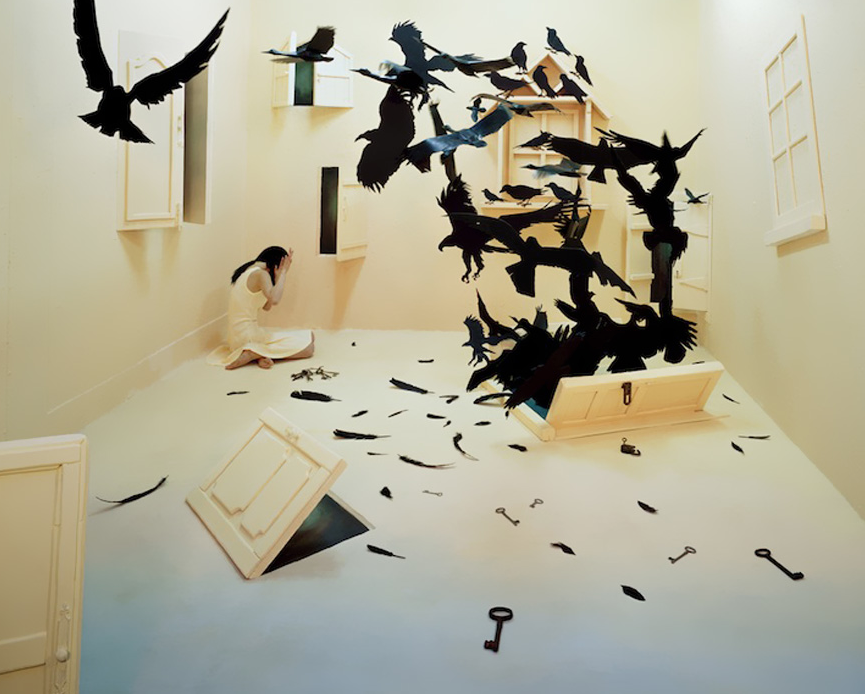
Young Korean artist Jee Young Lee recently presented her beautiful, surrealistic and Photoshop-free photography exhibition named “Stage of Mind”. The magic happens in the artist’s small 3,6 x 4,1 x 2,4-meter studio in Seoul. The artist builds these highly dramatic, psychedelic and visually intense scenes herself, ensuring that every teeny tiny detail is hauntingly perfect and leaves the viewer in awe.
Jee Young Lee works with such precision that the creation of a set often takes weeks or even months of work. As soon as the otherworldly sets are done, the artist incorporates herself in them in various different ways and takes these stunning self-portraits.
According to the artist herself, all of the photography sets and her specific roles in them tell a particular story about her personal life experiences or resurrect traditional Korean fables or other cultural heritage from around the world. Her work is a deep self-reflection for the artist and a means to explore her psychological identity.
Jee Young’s amazing work will be on display at the OPIOM Gallery in Opio France from Feb. 7 to March 7, 2014.
Take a look at Jee Young Lee‘s photos and embrace her enchanting world!