Mostrando las entradas con la etiqueta sideshow. Mostrar todas las entradas

domingo, 5 de enero de 2014

Dr. Couney and the Coney Island 'Child Hatchery'.


Theme Park History: Dr. Martin Couney and the Coney Island 'Child Hatchery'

Written by 
Published: October 20, 2013 at 10:25 AM

Of all the stories in theme park history (and perhaps medical history), one of the most curious has to be the story of Dr. Martin Couney.
Dr. Martin Couney
Born in 1870 in Germany, Dr Couney was one of the early pioneers of neonatology. He helped to develop the baby incubator and methods of caring for premature babies. In the late 1890s, his senior associates tasked him with spreading the word of the new technology to doctors and hospitals. Couney developed an exhibit and began demonstrations at fairs and expos around the world. The exhibits proved to be very popular, but more so with the curious general public than the medical industry they were intended to reach. The exhibit generated considerable crowds and revenue, but doctors and hospitals just weren’t that interested at the time.
After traveling exhibitions throughout Europe and the US for a few years, Dr. Couney set up a permanent exhibition in the newly opened Luna Park at Coney Island. In those days, hospitals had no special care for premature babies, so Couney was never short of patients. The outside of the building was no different than the other sideshows surrounding it. The sign above the door read “Life Begins With The Baby Incubator.” Customers were enticed in by a carnival barker and charged 25 cents to come and see the “child hatchery.”

Coney Island incubator exhibit
The inside was essentially a hospital. The atmosphere was quiet and clinical, incubators lined the walls, and trained nurses were employed to care for the babies. One of the nurses was Couney’s daughter, who ironically enough was born premature and spent some time in the incubator herself. The wet nurses employed to feed the babies were ordered on diets, and were fired if caught eating a hot dog or some other fried fare from the boardwalk. Tour guides were fired if they made jokes during the presentation. The rules and regulations for infant care were strictly enforced, and professionalism was emphasized. It was important to distinguish themselves at least a little from the pandemonium surrounding them.

Coney Island nurses Coney Island incubators
Naturally, there were those opposed to the idea of putting premature babies on display for the purposes of entertainment and profit. More than once there was a movement to shut him down. Dr. Couney had his reasons though, for throughout the show’s existence, he never charged a cent to the parents of the children he treated. It was the revenue of the paying customers covering the very high operating costs. He never took a payment for his services, and he accepted children of all kinds. Race, economic class, and social status were never factors in his decision to treat. The names were always kept anonymous, and in later years the doctor would stage reunions of his “graduates.” The medical profession that had once called him into question eventually embraced his methods and began promoting their use and sending him patients. Dr. Couney would eventually open more incubator attractions…a couple more at Coney Island and a handful around the country at other amusement centers and fairs.
Eventually, the enormous expense of running the exhibits began to outweigh the revenue as public interest in the attraction waned. Dr. Couney had made his case for the preemie though, and almost forty years after attraction opened, the first research center for premature infants was opened at Cornell University’s New York Hospital, reportedly differing very little from his operation. By this time, other hospitals were also opening treatment centers of their own. In 1943, Couney declared his work “finished” and closed for good. It’s reported that over 40 years of operation, Couney’s incubator attractions had an 80% success rate and saved about 6500 newborns from almost certain death. He died a few years later in 1950, having left his mark in both the theme park and medical industry.

martes, 20 de agosto de 2013

Blanche Dumas, the Three Legged Courtesan


Blanche Dumas was born on the Caribbean island of Martinique in 1860, to a French father and a biracial mother. She had a third leg attached to her sacrum, and her two primary legs were said to be imperfectly developed. The third leg was without a mobile joint but had a bend in it where the knee would have been. 


Her pelvis was wider than normal and she had double genitalia as well as a duplicate bowel and bladder. To the right of her middle leg was the stump of another limb; it's unknown at this time whether this stump was naturally occurring or the site of a surgical amputation, but promoters sought to maximize its appeal by adorning it with nipples and advertising it a pair of "well-formed" extra breasts!

Stories of Blanche all mention her pronounced libido. She moved to Paris later in life and became a courtesan, and allegedly, upon hearing about the three-legged, man with two penises and four testicles, dos Santos, who was touring at the same time, she expressed a desire to have sex with him. According to Gould and Pyle, "There were two vaginae and two well-developed vulvae, both having equally developed sensations. The sexual appetite was markedly developed, and coitus was practised in both vaginae."

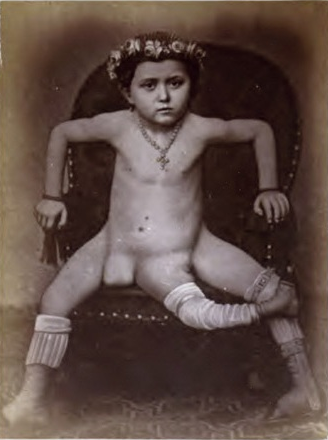
Left: Rare photo of young Blanche Dumas, clearly showing her undeveloped (or amputated) fourth leg. Right: Adult, sexualized Blanche with nipples painted on her leg stump. This is the basis for the woodcut above. Both photos submitted by an anonymous reader.

jueves, 3 de enero de 2013

Violetta, the Half Woman


Amazing Account Of A Limbless Beauty Show

by Wallace Stort London Life January 27, 1940

"The next stage was the central one of the five that formed the semicircle. I stood out from and was rather more ornate than the others, and obviously its occupant was the star attraction of the show.
The name of it above in brilliant Neon lights was "Violetta," and the lady was no stranger to me, as I had seen her and chatted with her two or three times before. Older readers of "London Life" may remember that I have referred to her more than once in my articles.

Violetta is probably the most outstanding of all the limbless ladies on exhibition, and is, I think, at the moment the only example of her particular type now before, at any rate, the American public. While the lecturers were busy with the other attractions, she remained perfectly calm and detached, neatly poised on her slender-stemmed, heavily brocade-topped pedestal, set in the centre of the stage. Now and then she would glance aloofly at the staring crowds, apparently undisturbed by their curiosity.
I remember her as a rather plain schoolgirl of 17 or 18, just over from Germany with her fair hair worn in a straight, flat fashion that did not add to her attraction. But that was ten or more years ago. Nowadays she has blossomed out into a real beauty, her blonde hair beautifully marcelled, her piquant face attractively made up, still grave and aloof, but undeniably charming.

Violetta possess a perfect figure, firm, beautifully curving bust, small neat waist and slim, rounded hips. But those are the beginning and end of her charms. She is merely a beautiful torso, completely without either arms or legs, even to the rudiments of limbs. Except that the usual limbs are absent, there is no suggestion of deformity about the neat trunk, which would not suffer comparison with that of any beauty queen or national Venus. In fact her usual billing, in her case no exaggeration, is as the "Beautiful Armless and Legless Venus."
According to her medical history, the torso is not only faultlessly modelled, but is without blemish of scar of any kind. Doctors and artists who have examined her have actually stated that, in her case, the absence of limbs constitutes no deformity. The doctors' verdict is that "the formation of the body is perfect within its own limits, and no provision has been made by Nature for the presence or functioning of limbs". And artists have described the wonderful torso as "a perfect, if unfinished, piece of natural sculpture."

When I first saw Violetta on her arrival in the States from Germany, years ago, she was very modestly clad in a costume of unrelieved black velvet, moulded to her figure, certainly, but quite opaque and clothing her from neck to hips. She still remains faithful to that type of costume, but it has subtly altered and has become much more alluring and revealing. The costumes of hers, by the way, can only be described as a specially designed figure-moulding pocket into which the torso is neatly fitted by her maid. The particular one she was wearing at this moment - with, by the way, a profusion of glittering necklaces - was of sheer black silk of a cobwebby fineness and transparency and clinging with the unwrinkled perfection of a skin-tight silk stocking. In fact it was obviously drawn on and smoothed into position exactly like a silk stocking.
I should say that the whole costume, when stripped from her, could easily be crushed into a loose, flimsy ball within one's closed fist. I could certainly be said to cover Violetta's charms from armless shoulders to shapely hips, but every curve and rounded contour of the beautiful torso was as fully revealed, and much more alluringly, as if she had been nude. AS she rested, gracefully poised on the cushioned top of her pedestal, one could easily note the faultless perfection of the limbless body.

At length the lecturer came round to Violetta's stage. She at once became the professional artist, aware of her public, bowing to right and left, with a charming, unaffected smile, as the man orated about her wonderful and unique charms in the usual highly eulogistic manner. He hoped that nobody would be so foolish to be sorry for her, as Violetta would be most hurt and would not regard it as a compliment.

She was perfectly happy and contented. In fact he could let the audience into a little secret and tell them that Violetta did not think a great deal of limbs in general. She did not think them particularly attractive and, for her own part, thought she was better without them. (In which, by the way, though the audience thought it a good joke, there is more than a little truth, and Violetta is not the only one of her kind to have the same strange, but compensating outlook. And on this occasion Violetta, while the audience was laughing, nodded and smiled vigorously, obviously in full agreement with the lecturer).

He suggested that she would make an excellent and economic wife for any enterprising young man, as she could never run away from home, and would save him a fortune in shoes, stockings, gloves, etc. But he did not tell his laughing audience that Violetta, as I knew, had been happily married for some years, and that round her neck, along with the gleaming rows of necklaces, she always wore a thin, gold chain on which hung her engagement and wedding rings, which she could wear in no other way.
After the lecturer's introductory remarks, Violetta presented her act; and a very remarkable act it is, revealing to the astonished spectators who see her for the first time the surprising fact that a totally limbless girl may not necessarily be absolutely helpless.

She is attended to during the performance by a very pretty nurse (who is, in fact, her maid) clad in a stunning uniform of brief, little more than hip-length skirts and silk tights, that no ordinary nurse could possibly wear. The nurse comes forward and first of all places on the floor below Violetta's pedestal (which, by the way, is about two and a half feet high, bringing its occupant up to about normal height) a thick mat of brightcoloured, cushioned rubber, and round it the materials for the act.
She then releases a catch in the top of the pedestal on which Violetta rests, and allows it to tilt forward slightly. Violetta drops to the mat in a graceful, flexible swing, and manages miraculously to remain upright in a perfect balance. After that she looks after herself, though the nurse hovers round solicitously all the time to offer help if necessary.
The extraordinary thing is that she is able to move about the mat quite easily, jumping or hopping - however you would describe the action - rather like a man in a sack race, only much more gracefully and effortlessly, and keeping her balance most of the time. Sometimes, in fun, she rolls right over, head first, she is coming at the end of the roll to an easy upright position again.
Meanwhile, using only her lips and teeth, she places in position a small easel, and upon that a pad of drawing papers. Then, with a charcoal pencil in a long holder, held between her teeth, she sketches in rapid succession, cartoons of well-known people, the nurse tearing off each finished drawing in turn and tossing it into the audience, to be grabbed by eager hands. In the same way, using only her wonderfully flexible lips, teeth and tongue, she opens a cigarette box which stands on a low table, selects a cigarette, and shifts it expertly to the corner of her mouth. Then, with her tongue she pushes open a matchbox - which, of course, is a fixture in a small chromium stand - and picks out in some miraculous manner a match. The cigarette is now between her lips in one corner, and the match between her teeth in another. She strikes the match, brings the end of the cigarette and the lighted end of the match together, lights the cigarette, and blows out and spits out the match. The trick is one that you'd think impossible until you see it, and then it looks almost easy!
She also demonstrates, in pantomime, how she can, if necessary wash herself practically all over. Again she uses her teeth, holding a sponge between them; and by contorting her amazingly flexible limbless torso into every conceivable position, she keeps the sponge moving lightly over her body. At one time she had rolled herself into a compact ball, "showing," as the lecturer humorously remarks, "how easily Violetta manages to make both ends meet!"
You would imagine that the feat of threading a needle and sewing, using only the tongue, teeth and lips, would be an impossible one. But this Violetta demonstrates is also comparatively simple to an ingenious mind. She picks the needle up with her tongue and lips, and sticks it point downward into the wood of her table, using her closed teeth to drive it home. Then she uses her tongue to pick up the thread, and manipulates it easily and swiftly into position with her lips and, bending down, threads the needle expertly. The sewing seems a more difficult business, but the fact is that Violetta's lips have become almost as flexible as fingers, and she seems to find no trouble in the task.
At the end of the remarkable little show she hops easily to the end of her mat and bows and smiles to the tremendous applause Then, turning to the nurser who stoops towards her, she crouches lightly and hops upwards into the nurse's arms. The nurse, with the beautiful limbless body in her arms, now steps down from the stage and carries her mistress among the audience, with which she chats in a smiling, friendly manner. She answers all sorts of questions about herself, even the most impertinent, with a laugh, and allows anybody who wishes to touch and smooth her body, in order to prove to themselves that she is "real and not an illusion."
The only thing she bars is kissing - which, believe it or not, many young men, as well as some women, attempt at nearly everyone of her performances. She has a way of using a shoulder, as she rests in her nurse's arms, that a boxer might, and the unexpected jab to the chin of a too ardent admirer is sometimes calculated to bring tears to his eyes!
Finally, Violetta is borne back to her pedestal, where the nurse settles her comfortably, and she returns to her grave and aloof contemplation of whatever is she thinks about, until the time comes round again for her turn.

martes, 19 de junio de 2012

Melvin Burkhart, The Original Human Blockhead

Born:  Born 1907 Louisville, KY, Died November 8, 2001 Gibsonton, Florida. Biography: From his obit(Associated Press):

TAMPA, Fla. (AP) - Magician Melvin Burkhart, known in the heyday of
carnivals as ``The Human Blockhead'' for his ability to hammer a spike
into his head through a cavity behind his nostril, died Thursday. He
was 94. 

Burkhart could make both sides of his face do different things, and he
could squeeze into enough shapes to be known as ``The Anatomical
Wonder.''

``He was 60 years in the sideshows, and he's the last of them,'' said
friend and magician Bill Dahlquist. ``It's the end of the era, it
really is. It's sad.''

Burkhart recently was in New York to trade stories with friends and to
perform at a wedding. When he returned home, he checked into a
hospital, and shortly afterward suffered a stroke. He had time for
private goodbyes before his heart gave out.
 
``He taught me how to be a rich man,'' said his son, Dennis Burkhart, a
biochemical engineer. ``He said a rich man is someone who can make one
person smile everyday. If I can be half the man my father has been, I
will be a great man.'' 

The elder Burkhart and his wife, Joyce, with whom he had three
children, were to celebrate their 52nd anniversary this month.
``He did what everybody else always talked about doing,'' said
daughter-in-law Jane Burkhart.

``He ran away and joined the circus.'' 


from James Taylor (excerpt of an unpublished essay, "How I Spent My Carny Vacation," 1998):

You've seen the act before, though the horrific elements of it probably had you wondering, "Why in the hell would anybody do that?" more than, "Who came up with that act?" Human Blockhead or just Blockhead, the act's straightforward and frightening: The performer takes a hammer, a bottle, the microphone, whatever, and with a maniacal laugh proceeds to pound a spike as big as your finger right into the middle of his head. Well, that's right up his nose. Maybe you saw the blockhead push an ice pick up his sinuses. Regardless, whether you saw it with those implements or others, when the act's done for comedy, a stand-alone act for the gross-out stand-up, it's origins are traceable to Gibtown. Specifically, to Melvin Burkhart, the Anatomical Wonder. The man Robert "Believe It or Not!" Ripley dubbed the Human Blockhead. The man who took a pretty gruesome piece of fakir performance, made it even more gruesome, and then made it comic. 


Melvin's done the act a million times. Taught it to a million wannabes who've taught it to a million others. Some of them don't even bother to invent their own patter. If he'd had a copyright on that material and the wherewithal to file suit, Melvin would be a millionaire by now, that is, if you could ever collect from other blockheads. As it is, he's just proud to know he's left his mark on the business. And on any given day, he'd just as well be doing magic anyway (yes, he's invented acts there, too). 


On the day Kathleen and I stopped by to see him this year, he told us before we left that we had to watch him do one more card trick. "I think you'll like this one," and he was all self-deprecating in tone, a sure sign from Melvin he's setting you up. True to form, he handed Kathleen the deck, told her to cut the deck anywhere, look at a card, not show it to him, hand it back, let him shuffle, he gave them back... and he never touched them again. And for the next five minutes, Melvin pretty much told her to do whatever she wanted with the deck. Cut them where she wanted. Divide them into a couple piles anywhere she chose. Pick left, right, middle, her choice. And when it was all over, Kathleen having apparently controlled the entire show, Melvin told her to make a final choice between the face-down piles. Any choice at all. She chose. Randomly. Of course she chose her own card, the one she'd picked at the beginning of that little performance. "That," she said, no small amount of awe in her voice, "was really good." "Good?!" Melvin came back, laughing through it, "That was perfect!" And, as always, he was right.

(1998)

Source

lunes, 5 de diciembre de 2011

Gandini’s Circus

Gandini’s Circus

Heading down busy Kelly Ave in downtown Edmond, passing an Arby’s and a gas station, you wouldn’t think anything of the obscure dirt road blocked off by a yellow fence.
At first you may just notice a barren field and nothing else, but it doesn’t take long to realize the full history of this strange, abandoned plot. Concrete foundations checker the tan grass while rusty metal poles protrude out of the bushes and trees. There are several houses that have
long since been vacated and later vandalized by passers-by. Further into the acreage, hidden behind some thick brush, you’ll start getting an idea of what this place used to be.
Gandini’s Circus went on for some time between the 1900′s and 1930, touring across various parts of the states. Fragments of the circus still linger around including 4 or 5 trailers where the clowns, acrobats and animals were housed. 
Even the cages, large and small, are still there– discarded when the circus apparently disbanded. Although many of the trailers are burnt from the inside out by either arson or a terrible accident, you can still find fliers, popcorn bags and soda cups along with assorted pieces of memorabilia throughout the area.

What makes the area so spooky is not the place’s background, but it’s lack of obvious history. I’ve tried to search the Internet for information on the circus but could only find a few pages vaguely relating to what it was. Digging through the ashes in and around the trailers I was able to find a few old fliers in tact that shed some light on the place, but still not enough to make this area any less frightening.

The real scare comes at night, walking through this barren place, maybe tripping over an old cougar cage or deflated clown ball, when the full scope of what ‘haunted’ really boils down to. 


Afterall, there may be nothing more dreadful than a haunted circus burned to the ground. A place does not necessarily require ghosts to be haunted, but if it’s scary enough, maybe we’re the ones who create them.

-Written by Robert Cole

Images and Words from Source


jueves, 1 de diciembre de 2011

Minerva and Charmion- Strongwomen


MINERVA & CHARMION – Strongwomen

JosephineBlatt 754548 MINERVA & CHARMION   Strongwomen

The strongman has long been a staple in circus and sideshows. The image of handlebar mustached man garbed in a leopard print leotard has become the stereotypical image associated with feats of extraordinary strength. But, what about the ‘fairer sex’? Was there ever a professional strongwoman?
Truth be told, there were several.
Perhaps the best known and traditional of these brawny babes was Josephine Blatt, who was better known by her stage name Minerva.
Josephine Blatt’s early history is shrouded in carnival gimmickry. She claimed to have been born in 1865 in Hamburg Germany but other sources, most notably The Guinness Book of World Records, pegged her as an American born in 1867 in Hoboken, New Jersey. Regardless of this discrepancy, few questions exist in regards to her remarkable strength.
In her displays she demonstrated her strength by breaking horseshoes with her hands, breaking steel chains by expanding her chest, and playing catch with a 24 pound cannon ball.  

charmion 774226 MINERVA & CHARMION   StrongwomenShe was capable to lift a stone weight of 360 lbs with a single finger thrust through a lifting ring. Furthermore, The Guinness Book of Records recognized Minerva as having lifted the greatest weight ever by a woman. 

At the BijouTheatre in Hoboken on April 15, 1895 Josephine Blatt lifted 3,564 lbs in a hip-and-harness lift. With that superhuman lift, Josephine Blatt nearly achieved the mythical status of her namesake

 She retired with her strongman husband, Charles Blatt, in 1910 and eventually passed away on September 1, 1923.
Around the same time that Minerva was raising great weights, a young lady named Charmion was raising eyebrows with her unusual strength-related act.
Laverie Vallee, Charmion, was a Sacramento born trapeze artist who possessed strength and a physique most men would be envious of. However, she was most well known for her risqué striptease performances.
The act opened with Charmion taking the stage in full Victorian attire. She would then mount the trapeze and proceed to undress to her leotard while performing impressive and strength-dependant stunts. The act was incredibly impressive and provocative for the era. However, the controversy created by her performances did not prevent the formulation of a devoted, and mostly male, fan base.
One of her greatest fans was Thomas Edison. As a result of that adoration, on November 11, 1901 Charmion committed a simplified version of her act to film for Edison. The film, simply entitled ‘Trapeze Disrobing Act’ focused more on the erotic aspect of the performance, though a few remarkable feats of strength are featured. The film can be viewed here.
Charmion eventually retired to Santa Ana, California. She passed away on February 6, 1949 at the age of 73.


Information and images taken from thehumanmarvels.com 

miércoles, 5 de octubre de 2011

Sideshow 1901-1940


Here is a little glimpse into sideshows of the past...times have changed in some ways and yet in others they have not at all! 


A Clown and a donkey circa 1930


Miss Claire the Lion Trainer having tea. 


1930s MEN and WOMEN of CIRCUS in makeup and costume


1930s Circus Clown With Big Book


1930s circus acrobats aerialists LILLIAN LEITZEL and ALFREDO CODONA


1915 Circus Barnum and Bailey 1910s Tent Exterior


1909 BARNUM and BAILEY Circus Parade 1900s SHELDON IOWA Main Street vintage photo crowd


1906 CIRCUS TENT INTERIOR BLEACHERS


1901 CIRCUS MAX SCHREYER Daredevil Ramp Crowd Bicycle Flying 1900s Vintage Photo


Gabrielle, the living Half Lady, 1890