
A stunning set and brief history by the wonderful Mr. Motts, enjoy.

"The Brothers," as the islands are often called, are located in the East River, between Queens and the Bronx, NYC. They were claimed in 1614 and dubbed "duo De Gesellen" (or "The Companions"), and were left unoccupied for quite some time due to the strong and dangerous currents surrounding them. South Brother Island is the smaller of the two, and was only home to a private summer home for a few years until it burned down in 1909; it was purchased by Hampton Scows for $10.00 in 1979 and subsequently sold to the City of New York in 2007 (for around $2 million) to be preserved as a wildlife sanctuary. North Brother was purchased by the town of Morrisania (located in the Bronx) in 1871, and was home to a tuberculosis hospital built by the Sisters of Charity. The hospital was closed when New York City acquired the island in 1885 to build a new hospital for the treatment of infectious diseases. The diseases that were treated here varied as new germs invaded the city - they included smallpox, typhoid, tuberculosis, measles, diphtheria, scarlet fever, and polio.
"The Brothers," as the islands are often called, are located in the East River, between Queens and the Bronx, NYC. They were claimed in 1614 and dubbed "duo De Gesellen" (or "The Companions"), and were left unoccupied for quite some time due to the strong and dangerous currents surrounding them. South Brother Island is the smaller of the two, and was only home to a private summer home for a few years until it burned down in 1909; it was purchased by Hampton Scows for $10.00 in 1979 and subsequently sold to the City of New York in 2007 (for around $2 million) to be preserved as a wildlife sanctuary. North Brother was purchased by the town of Morrisania (located in the Bronx) in 1871, and was home to a tuberculosis hospital built by the Sisters of Charity. The hospital was closed when New York City acquired the island in 1885 to build a new hospital for the treatment of infectious diseases. The diseases that were treated here varied as new germs invaded the city - they included smallpox, typhoid, tuberculosis, measles, diphtheria, scarlet fever, and polio.
Many patients from the Renwick Smallpox Hospital
on Roosevelt Island were relocated to North Brother once the new
facility was built. A ferry located at 132nd Street in the Bronx
transported staff, patients, and supplies to the island, yet it remained
very isolated - there were no telephone or telegraph lines installed
until as late as 1894. There were also dangers with transporting
stricken patients in the winter, and much criticism was voiced after a
six month old baby infected with measles perished en route to the
island. During the turn of the century, overcrowding was a major issue
when an outbreak occurred; everyday medical instruments were in short
supply and were not cleaned or sterilized properly between the frequent
uses. Tents were used when no more beds could fit in the pavilions; the
cloth enclosures were precariously heated with wood burning stoves
during the harsh New York winters, and a few eventually wound up in
flames. The hospital had about 1,200 people in quarantine during a 1892
typhus outbreak.
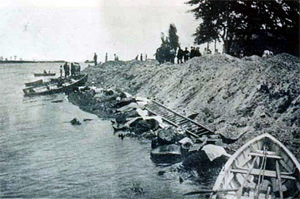 |
| Bodies of General Slocum passengers line the shores of North Brother Island, 1904 |
The most infamous patient that resided at Riverside might be Mary Mallon, also known as "Typhoid Mary." Mary was a carrier of typhoid, which means she had the disease but there were no symptoms or side effects, yet she could pass it to others. She worked as a cook at various places in Manhattan and Long Island between 1900 and 1907, where she transmitted the infection to a number of people. As they got sick or died she would find employment elsewhere, and she was soon questioned by health officials. Her response was that she did not believe she had the disease, and adamantly refused to cooperate. In 1907 Mary was taken into custody by police officers, and The Health Department gave her an ultimatum - either have her gall bladder removed (where typhoid carrier germs lived), or be exiled to North Brother Island. She refused the surgical operation, which was risky and unpredictable at the time, and was placed at the hospital for three years. Mallon resided in a bungalow, away from the main hospital buildings, and lived alone except for a dog as a companion.
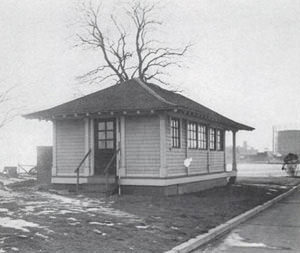 |
| Mary Mallon's Cottage at Riverside Hospital |
After
a lengthy court battle, where Mary described her life akin to a
prisoner's, she was released from the hospital in 1910. She immediately
returned to work as a cook under the pseudonym of "Mrs. Brown" at Sloane
Maternity Hospital. An outbreak of typhoid that consisted of 25
separate cases was eventually traced back to the cook, and officials
identified her as Mary Mallon. She was sent back to North Brother in
1915 to live the rest of her life there. She began working at the
hospital in 1918, becoming a nurse and finally a laboratory assistant.
Mary suffered a stroke in 1933, and remained bedridden at Riverside
until she died on November 11, 1938. She had infected a total of 47
people, 3 of whom had died from the disease.
In 1943 a large tuberculosis pavilion was constructed on the island, but was never used for that purpose (supposedly due to the lack of staff personnel required to operate it). The passing of the GI Bill resulted in the shortage of housing for the city's colleges, and the building was used as a dormitory while the island was leased to the state. College students were transported to and from the island via the E 134th Street Ferry Terminal, by ferry boats Mott Haven and Greenwich Village.
These same ferries were also used for adolescents being treated for drug abuse when the city took control of the island once again in 1952 and planned its final use as a rehab center for serious cases of addiction. The idea was to get adolescents far away from the overcrowded jails and hospitals filled with time-hardened criminals, with a maximum stay of six months. The TB pavilion was converted to treat 100 boys and 50 girls, placed there by their parents or the court system. New admissions were bathed and searched for drugs, then placed in observation wards as they went through withdrawal "Cold Turkey." If the symptoms were too severe, they were tapered off the drug. The program turned out to be rife with corruption by the 1960s, and Riverside Hospital closed in 1963, leaving the entire island abandoned. It is currently off-limits to the public and patrolled often due to the proximity of a nearby prison complex on Rikers Island, as well as joining the purpose of its brethren as a bird sanctuary.
In 1943 a large tuberculosis pavilion was constructed on the island, but was never used for that purpose (supposedly due to the lack of staff personnel required to operate it). The passing of the GI Bill resulted in the shortage of housing for the city's colleges, and the building was used as a dormitory while the island was leased to the state. College students were transported to and from the island via the E 134th Street Ferry Terminal, by ferry boats Mott Haven and Greenwich Village.
These same ferries were also used for adolescents being treated for drug abuse when the city took control of the island once again in 1952 and planned its final use as a rehab center for serious cases of addiction. The idea was to get adolescents far away from the overcrowded jails and hospitals filled with time-hardened criminals, with a maximum stay of six months. The TB pavilion was converted to treat 100 boys and 50 girls, placed there by their parents or the court system. New admissions were bathed and searched for drugs, then placed in observation wards as they went through withdrawal "Cold Turkey." If the symptoms were too severe, they were tapered off the drug. The program turned out to be rife with corruption by the 1960s, and Riverside Hospital closed in 1963, leaving the entire island abandoned. It is currently off-limits to the public and patrolled often due to the proximity of a nearby prison complex on Rikers Island, as well as joining the purpose of its brethren as a bird sanctuary.


Information and photos © www.opacity.us


